Posted:
Conventional wisdom suggests that the rise of digital is making local retailers obsolete. But the reality is much different—technology actually presents new opportunities to help savvy retailers connect with consumers, drive them to the store and increase sales.

To better understand the impact of smartphones and online information on in-store shopping, Google partnered with Ipsos Media CT and Sterling Brands to conduct an online survey. With this new research, we were able to uncover the real relationship between digital and local retail, as well as debunk three common retail myths.

Myth: Search results only send consumers to e-commerce sites.
The Reality: Search results are a powerful way to drive consumers to stores.

Many retailers believe that when shoppers look for products online, they limit their research strictly to e-commerce websites. In reality, three out of four shoppers who find local information in search results helpful are more likely to visit stores. When information about store location, hours and product availability is clearly communicated in a local search ad, shoppers are actually inspired to make the in-store purchase.

Head to Think With Google to learn more retail myths and uncover the realities about technology’s impact on local shopping.

Posted:
The 2014 holiday shopping season is nearly upon us, and some shoppers are likely already looking for gifts to purchase. This year, brands and marketers have the chance to connect with shoppers as they search for the perfect products throughout the season.

Data shows that shoppers are increasingly turning to mobile—last year, 40% of Black Friday's online shopping was on mobile. Marketers can use mobile to capture interest at the exact moment a customer needs information, and hopefully make a lasting connection between consumer and brand.

Visit Think with Google to read about all 5 trends marketers should know for the upcoming holiday season.

Posted:
(Cross-posted from the DoubleClick Search Blog)

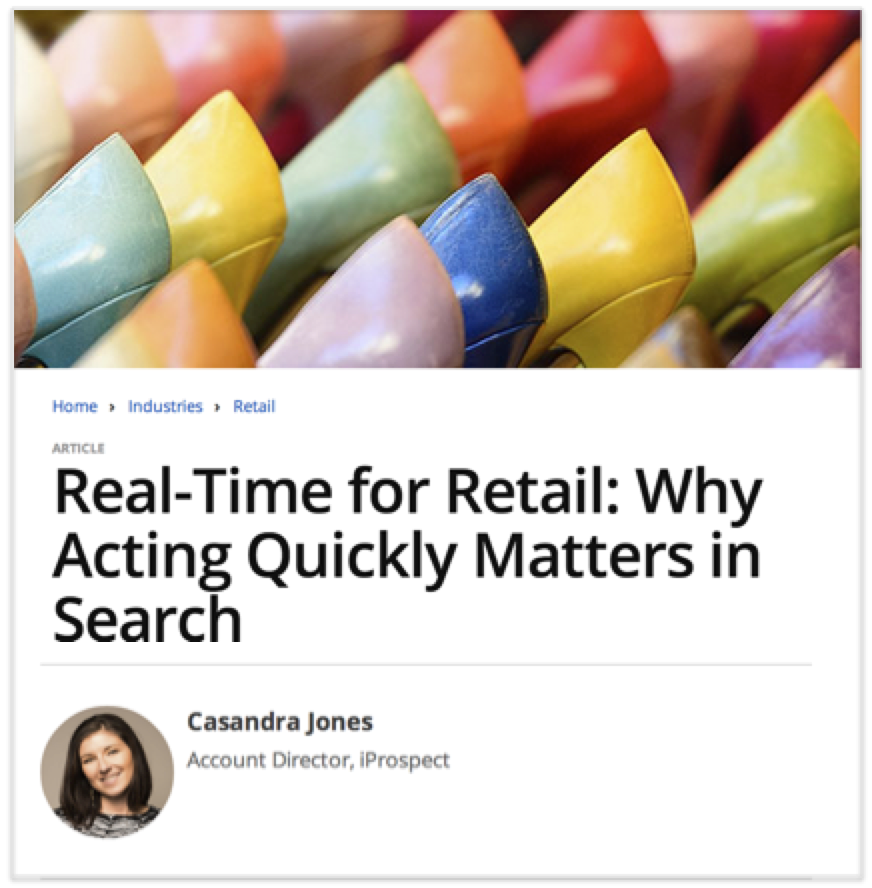
When consumers act, they act fast. Retailers can get a leg up in the marketplace by responding to consumers’ needs as they surface. While some events, such as holidays and championship games, can be anticipated, others, such as weather-related issues, cannot. Using real-time technologies in search, brands can dynamically adjust their reach, competitiveness and relevancy with their target audiences at the most critical times.

In a new Think Insights article, Casandra Jones, Account Director at iProspect, tells us the benefits of adopting SEM tools that act in real time to achieve search success as these important events and conversations occur.

Screen Shot 2014-07-20 at 8.40.04 PM.png

Check out Casandra’s article on the Think Insights page here, and let us know what you think on Twitter or our Google+ page.

Posted:
Marketers are increasingly turning to search advertising as a way to learn more about their brands and how they can better connect with consumers. L'Oréal Paris, for example, used search to reach a wide audience looking for information about the popular “ombre” hairstyle in 2012. At the time, this hair treatment was only done in salons, but L'Oréal Paris saw the potential in a home market product and it developed one in just a few months. The brand then created YouTube content devoted to the topic, got widespread press coverage, and owned the search for the term—all of which established brand awareness. In the end, the people who had alerted L'Oréal Paris to the trend saw search ads that linked to helpful information, at the moment when they needed it.


While search ads haven’t typically been part of the brand marketer’s toolkit, some like L’Oreal Paris are catching on to their value in building brand awareness. A recent Google/Ipsos MediaCT meta-study showed that search ads drove an average increase of 6.6 percentage points in top-of-mind awareness, from 8.2% to 14.8%—a lift of 80%.

 A new article on Think with Google looks at how brand marketers are understanding and and connecting with audiences using search. Check out the full collection for more details on the research, case studies and a guide for marketers on how to use search for brand marketing.

Posted:
Search data from Sunday night's Academy Awards reveals that women are taking style inspiration from the stars and are looking for Oscar dresses with an eye to buy. In fact, people search more for information on the dresses than they do for the nominees themselves.


Whose dress was most popular this year? And how are brands capitalizing on this interest? See more trends and insights we learned from Hollywood's biggest night on Think with Google.

Posted:
Brands are engaging their audiences on YouTube by creating powerful stories that integrate with their digital advertising campaigns. This issue of YouTube Insights sets out to help brands build strong connections with their fans in the most effective way. We showcase learnings from such brand stories, along with data and stats on audiences, and reveal the results of advertising on YouTube and other Google properties.

Join us for the YouTube Insights Hangout on 11/7 at 1pm EST moderated by Tara Levy, Managing Director, Google Ads Marketing. She will facilitate a discussion around the YouTube audience and methods for leveraging YouTube to successfully engage active viewers, including highlights from the You Insights Report.

Panelists include experts:
  • Mike Henry, CEO, Outrigger Media 
  • Ann Greene, Millward Brown 
  • Rob Davis, Executive Director, Ogilvy Content Practice 
  • Gun Johnson, Advertising Research Director, Google 

To RSVP and find out more information, please click here.

Posted by Linda Tao, The Google Think Insights Team

Posted:
Today, shopping is no longer limited to the mall - it happens at home, waiting in line, or at the doctor’s office. If you’re armed with a smartphone, every moment is now a shopping opportunity. As retailers gear up for this month’s back-to-school shopping crunch, we took to the digital Main Street to find out how consumer shopping patterns have changed. Focusing on apparel shopping, we analyzed consumer shopping behavior from the point of sale backward, and surveyed apparel shoppers to understand shopping trends.

We found that not only is online research playing an integral role than in both online and in-store purchases, consumers are increasingly shopping on their mobile devices and using online video to inform purchase decisions. In fact, 4 in 10 shoppers visited a store online or in-person as a direct result of watching a video online. Here are a few highlights from the report:

Mobile devices bring the mall to you

Mobile shopping is not a sporadic activity limited to weekend trips to the mall. It’s constant and pervasive. More than 1 in 5 apparel consumers are using their tablets or mobile devices on a daily basis for shopping. People are shopping on their mobile devices throughout all parts of the day - and not just while on-the-go. More than 69% of consumers shopped on their phone or tablet while at home, 31% while in a store, 28% while waiting in line, and 27% while at work.


People are using their mobile devices as shopping assistants by informing purchase decisions and helping them locate the best deal. Of people that shop on their mobile device, 56% compare prices and look for promotions, 42% read reviews, 38% search inventory, 16% scan bar code while in store, and 13% contact the retailer.


Video is the virtual fitting room
Aspects such as fit and quality - easily apparent in person - become harder to grasp when shopping online. Video has now filled the role as the virtual fitting room, enabling shoppers to hear personal opinions and reviews, and see the product in motion. In fact, video has become so influential that 4 in 10 shoppers visited a store online or in-person as a direct result of watching a video. Today, nearly 1 in 3 shoppers use YouTube to shop for apparel. So it’s no surprise that video ads top traditional media in encouraging purchases. Thirty-four percent of apparel shoppers are more likely to purchase after viewing an online video ad, versus 16% after watching an ad on TV.

Millennials (aged 18-34) are twice as likely than other age groups to rely on a video to decide which company to purchase from, and are regularly turning to YouTube for shopping advice. YouTube vloggers posting their latest shopping finds aren’t just sharing their recommendations with close friends, they’re sharing with an audience of thousands of subscribers and millions of views - MacBarbie07, a popular YouTube partner, has more than 100M views of her styling tips. And this fall we’re seeing even more shopping reviews on YouTube - there are nearly 600,000 shopping “haul” videos on YouTube, more than 35,000 of which were uploaded within the last month alone.


Digital shoppers are valuable customersPeople who shop on their mobile devices and research with video tend to not only spend more on average purchases, but do so more frequently. We found that 1 in 4 mobile researchers purchased apparel more than 6 times in the past 6 months (versus 16% of non-mobile researchers). And 28% of video researchers spent more than $500 on apparel in the past 6 months, while only 2% of non-video researchers did. This is just the tip of the iceberg. In the next 5 years we’ll see a bigger change to shopping than we’ve seen in the past 50. Download the full report for more insight into this year’s shopping trends. Visit Think with Google to learn how you can leverage these digital trends for your marketing strategy this year.

Posted by Todd Pollak, Industry Director, Retail, Google